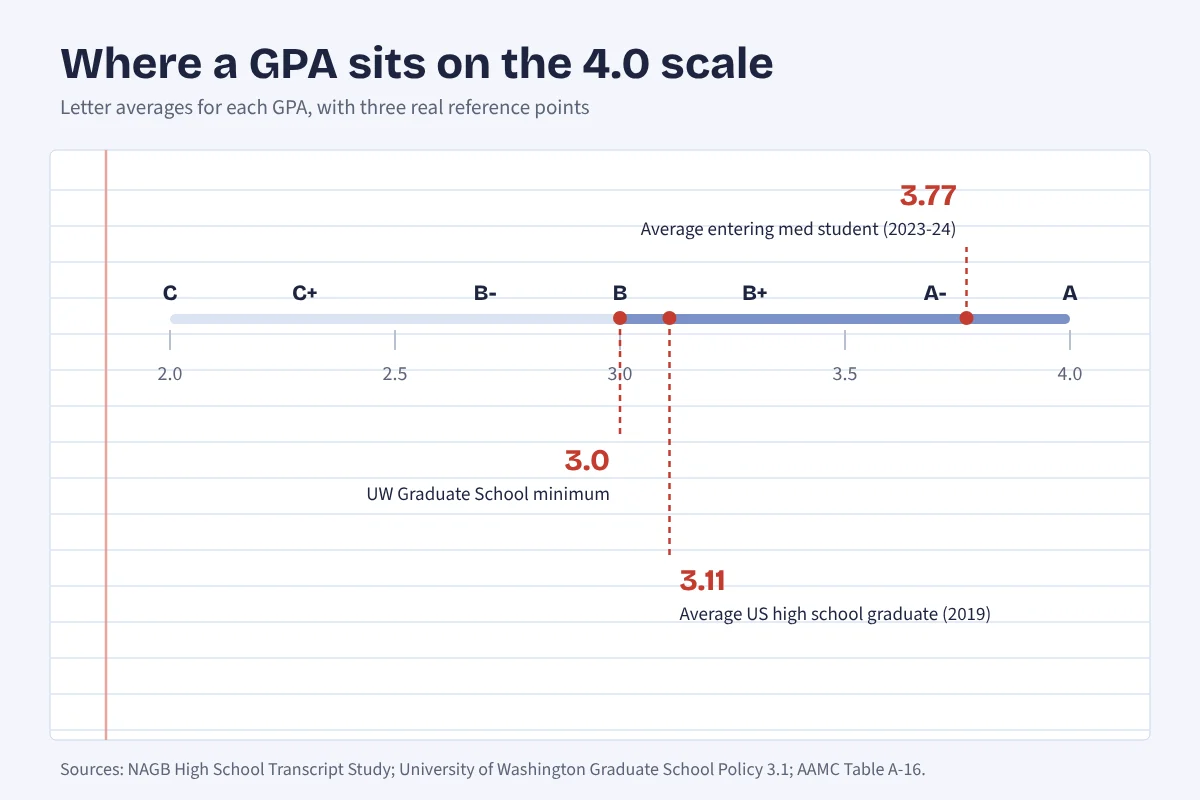
Whether a GPA is “good” depends on what you need it for. A 3.3 is comfortably above average for a high school graduate, but below the typical student entering medical school. Here’s what each GPA means, with real reference points.
What your GPA means in letter grades
On the standard unweighted 4.0 scale, an A is 4.0, a B is 3.0 and a C is 2.0. So your GPA is roughly your average letter grade:
| GPA | Average letter grade | In plain terms |
|---|---|---|
| 4.0 | A | Every grade an A (or A+) |
| 3.7 | A- | Mostly A’s, a few B’s |
| 3.5 | Between B+ and A- | About half A’s, half B’s |
| 3.3 | B+ | Mostly B’s with some A’s |
| 3.0 | B | A B average |
| 2.7 | B- | Mostly B’s and some C’s |
| 2.5 | Between C+ and B- | About half B’s, half C’s |
| 2.0 | C | A C average |
A weighted GPA, with extra points for honors and AP classes, can go above 4.0. See weighted vs unweighted GPA for how that works.
Real reference points
- The average US high school graduate had a 3.11 GPA in 2019, up from 3.00 in 2009 and 2.68 in 1990, according to the High School Transcript Study reported by the National Assessment Governing Board.
- 3.0 is a common minimum for graduate school. For example, the University of Washington Graduate School requires a cumulative 3.0 on a 4.0 scale. Individual programs can ask for more.
- Students entering US MD medical schools averaged a 3.77 GPA in 2023-24, against 3.64 for all applicants, according to AAMC Table A-16.
So, is my GPA good?
3.5 or higher. Above the average high school graduate and well clear of the usual 3.0 graduate school minimum. For the most selective colleges and for medical school, it’s competitive but not a standout on its own: the average entering medical student had a 3.77.
3.0 to 3.5. Around or above the high school average of 3.11, and at or above the common 3.0 graduate school floor. A solid GPA for most colleges, jobs and programs.
2.5 to 3.0. Below average for a high school graduate, and under many graduate schools’ 3.0 minimum. Still enough for many colleges and jobs, and the easiest range to raise if you have plenty of credits still to take.
Below 2.5. Check your school’s rules. Many colleges put students on academic probation below a 2.0, and some programs, scholarships and financial aid require a minimum GPA to stay eligible.
What matters as much as the number
- Course difficulty. Colleges see your classes as well as your GPA. A 3.6 with several AP classes can look stronger than a 3.9 with none.
- The trend. A GPA that rises each year tells a better story than one that falls.
- Weighted or unweighted. Compare like with like. A weighted 4.2 and an unweighted 3.7 can describe the same transcript.
How to raise your GPA
The more credits you already have, the harder your GPA is to move. A 2.7 over 60 college credits needs 18 credits of straight A’s to reach a 3.0. The same 2.7 over 120 credits needs 36. The raise GPA calculator shows exactly what you need for your numbers, and the GPA calculator works out a single term from your letter grades.
Common questions
Is a 3.5 GPA good in college? Yes for most purposes. It’s above the common 3.0 graduate school minimum, though very competitive programs like medical school often admit students with higher GPAs.
Is a 3.0 GPA good? It’s a B average, close to the 3.11 average for US high school graduates, and meets many graduate schools’ 3.0 minimum.
Is a 2.5 GPA bad? It’s below average, but not a dead end. Raising it is often realistic, especially early on when you have fewer credits behind it.